NEWS
June 2026: The Dance of the Qubits Visual Music Composition is Complete
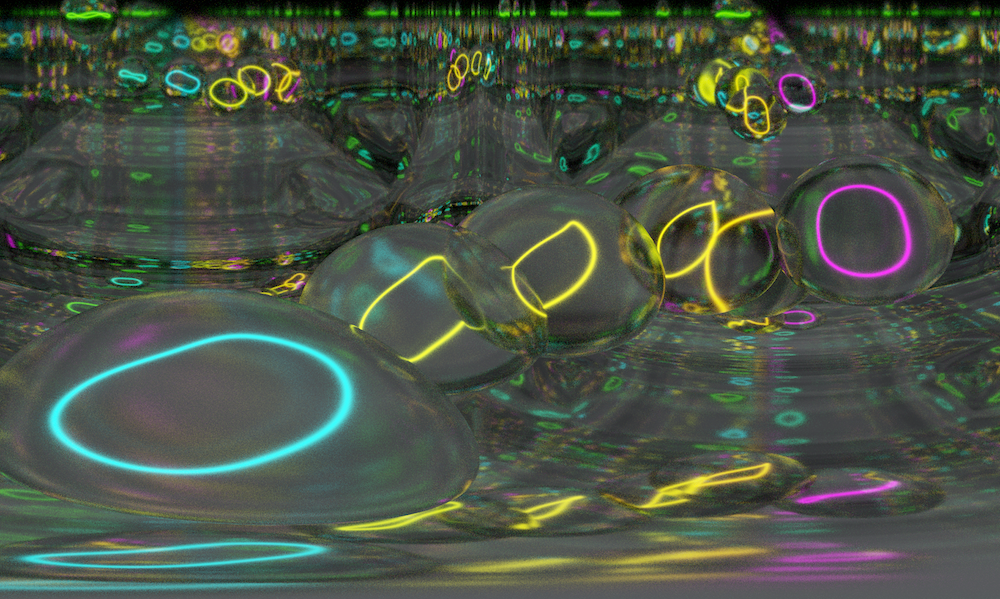
Dance of the Qubits is complete. The ~nine-minute stereoscopic audiovisual composition derives entirely from quantum state tomography data executed on Quantum Inspire’s Tuna-9 nine-qubit processor. Eight circuit schemas provide the source material, transduced directly into 32-channel spatial audio and 8K stereoscopic 3D/360° visual imagery. The work is available in various formats including: stereoscopic 3D/360° for proprietary systems, full dome, and stereoscopic flat screen. Dance of the Qubits is the culmination of Phase III of the Quantum Computational Creativity research program, developed in close collaboration with Machine Intelligence. A 2D version can be experienced here.
May 2026: Ball State University Awards Support for IBM Quantum Compute Time
Ball State University’s Institute for Digital Intermedia Arts (IDIA Lab) has awarded the Quantum Computational Creativity program $5,000 in support of additional ~50 minutes compute time on IBM Kingston, currently IBM’s newest and most powerful quantum processor. The award is funded through the Eli Lilly Endowment’s Artificial Intelligence Higher Education (AIHE) initiative. The grant will support Phase IV of the QCC research program, which targets a dynamic expansion of the transduction methodology developed across Phases II and III, engaging all 156 of Kingston’s available qubits simultaneously.
May 2026: QCC Render Engine Completed
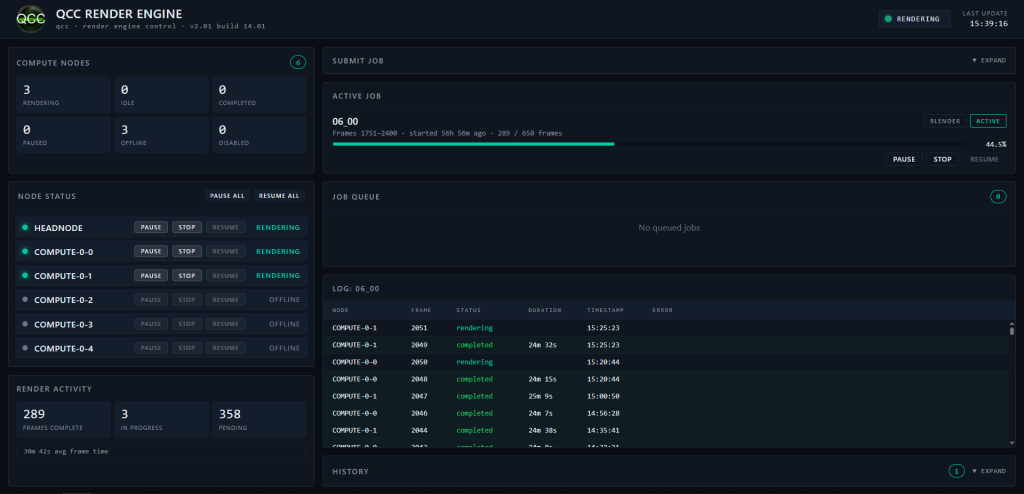
The QCC Render Engine (QCC-RE), a custom distributed render farm system, has been completed and deployed in production across the QCC studio’s multi-node high-performance computing infrastructure. The engine coordinates Blender and Maya image sequence rendering from a single web-based dashboard. It reliably manages 8K stereoscopic 3D/360° renders that transduce quantum wavefunctions into immersive virtual reality scenes. The QCC-RE is central to the Phase III and Phase IV research. The system was designed and built in collaboration with Anthropic’s Claude, Opus 4.7, over an extensive series of structured engineering sessions… a procedural approach central the QCC vision.
April 2026: IBM Quantum Compute Time Awarded
IBM has awarded Quantum Computational Creativity 180 minutes of compute time on IBM Kingston, which is currently IBM’s newest and most powerful quantum processor, featuring 156 qubits and 340K CLOPS. The award is valued at approximately $18,000 and is valid for one year. The credits will support Phase IV of the QCC research program, which explores a dynamic expansion of previous work to twelve circuit schemas each utilizing thirteen qubits, thus engaging all 156 of Kingston’s available qubits simultaneously.
February 2026: Reflections from Hilbert Space
Reflections from Hilbert Space, the Phase II album of quantum computer music, is now streaming from the QCC website. The collection of seven compositions — totaling approximately 76 minutes of high-order Ambisonics spatial audio — traces the development of the QCC transduction methodology from initial simulation-based explorations through its first execution on quantum hardware. The culminating work, The Infinite and the Infinitesimal, is derived entirely from execution on Quantum Inspire’s Tuna-9 processor. Listen here.
February 2026: Paper Submitted to Computer Music Journal
A research paper documenting the methodologies and findings of Phase II of the Quantum Computational Creativity program was submitted to the Computer Music Journal’s special issue on Quantum Computer Music. The paper presents the transduction methodology developed through Phase II and its application to the creation of several quantum computer music compositions, collectively titled Reflections from Hilbert Space. The paper is currently under review and can be read here.