
PHASE IV – Expansion (work in progress)
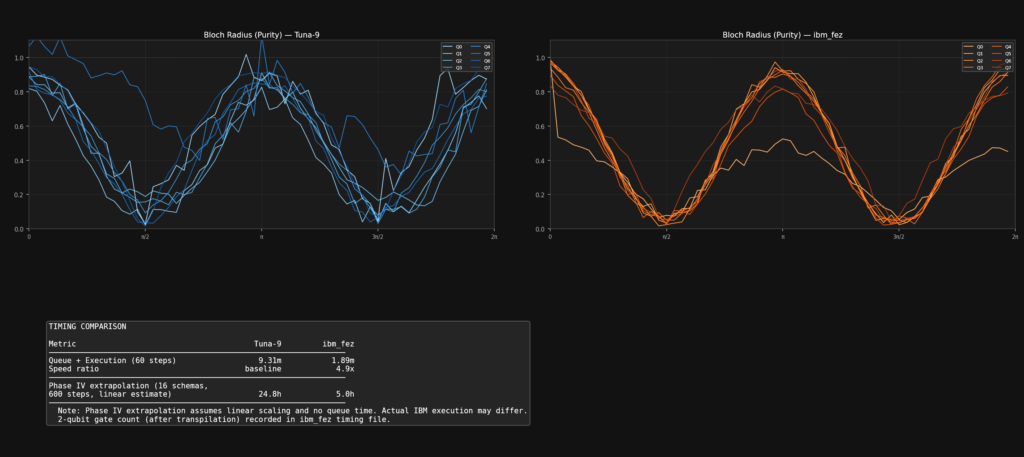
Phase IV represents a major up-scaling of the methodologies employed in the previous phases. Initially the goal was to expand to sixteen nine-qubit circuit schemas, which would have engaged 144 of the IBM Kingston backend’s 156 available qubits. However, as the project has progressed, it is now engaging all 156 available qubits in a single circuit. Novel circuit topologies, an expanded native gate vocabulary, and non-uniform parameter sampling will produce a unified body of stratified waveforms of far greater complexity and variety than previous phases. The raw material generated by these processes will be transduced to distinct quantum computer music and stereoscopic visual music compositions. Benchmark testing on IBM’s ibm_fez processor confirms the methodology executes at 4.8× the speed of the previously used Quantum Inspire Tuna-9 backend, making this ambitious expansion feasible. QCC was awarded 180 minutes of quantum compute time by IBM, which will enable the first steps of the project and an IBM Quantum Credits Program grant application was submitted to further support its completion.
Purpose of this Document
This document records the conceptual discussion between Dr. Michael Rhoades and Claude (Anthropic) regarding Phase IV of the Quantum Computational Creativity research project. It is intended as a reference for when active development begins, preserving the creative and technical intentions formulated during the planning stages. It also serves as supporting context for the IBM Quantum Credits Program grant application.
Overview
Phase IV represents the most ambitious execution of the Quantum Computational Creativity methodology to date. Sixteen circuit schemas, each utilizing nine qubits, will engage 144 of IBM Kingston’s 156 available qubits in a single large-scale hardware execution. This is not simply a scaling of previous phases. Phase IV introduces fundamental changes at the circuit architecture level, changes driven directly by discoveries made during Phase III development that exposed both the limitations of the previous approach and the path beyond them.
A pilot execution on April 1, 2026 confirmed that 144-qubit parallel circuit execution on Kingston is fully viable: 6,816 circuits executed in 7 minutes 47 seconds of quantum time, at a calibrated rate of 0.069 seconds per circuit. 180 minutes of compute time on Kingston were subsequently made available following usage that exceeded the 20-minute threshold, valid for one year from April 2026. This resource provides the foundation for the initial steps of Phase IV execution. A separate application to IBM’s Quantum Credits Program, requesting extended compute time to support full-scale execution, has been submitted and is currently pending review.
All Phase IV circuit designs will be validated in Qiskit Aer simulation before any IBM compute time is committed. This simulation-first discipline, established during Phase III development, ensures that hardware execution is reserved for designs that have demonstrated their value and viability computationally.
The IBM/Quantum Inspire hardware comparison benchmark, documented fully on the quantumcomputationalcreativity.com research pages and reproduced in the hardware section below, provides the empirical foundation for the compute time estimates submitted in the grant application.
Discoveries from Phase III that Inform Phase IV
Three specific challenges emerged during Phase III audio and visual development. Each is inherent to the Phase III circuit architecture and cannot be resolved in post-production. Each must be addressed at the circuit design level in Phase IV.
The Chord Challenge
Within each Phase III schema, all eight qubits evolve together through the same parameter sweep, arriving at significant quantum states simultaneously. When complex samples derived from Bloch sphere trajectories are played back across all eight voices at once, the result collapses into an undifferentiated mass. Individual voices cannot be tracked perceptually. The solution requires circuits in which different qubits arrive at significant states at different times — temporal separation built into the quantum architecture itself.
The Waveform Similarity Challenge
Phase III tomographic waveforms are too similar across qubits and across schemas. Entanglement keeps qubits correlated, which is physically accurate but compositionally limiting. The eight voices within a schema move together rather than independently. Phase IV circuits must be designed to produce genuinely distinct waveform shapes between qubits, with timbral variety arising from asymmetric gate structures rather than from post-production manipulation.
Unified Temporal Phrasing
A third insight functions less as a challenge and more as a design opportunity: if non-uniform temporal distribution is built into the circuit execution through non-uniform parameter sampling, then audio and visual material emerge from the same underlying temporal structure from the beginning. The phrasing is not imposed on the data after the fact. It is inherent in the quantum execution itself. This is the deepest realization of the QCC unified methodology to date: compositional phrasing as an emergent quantum phenomenon, arising from the circuit execution rather than from artistic interpretation applied afterward.
Phase IV Design Principles
Principle 1 – Temporal Separation by Design
Phase IV circuits are designed so that different qubits arrive at significant quantum states at different times. Approaches under development include staggered parameter sweeps, sequential entanglement activation, and topology-driven temporal structure. The entanglement topology becomes the compositional structure. The physics and the music are unified at the circuit level rather than reconciled afterward.
Principle 2 – Timbral Variety by Design
Phase IV circuits move away from uniformly scaled rotation gates toward asymmetric gate structures that produce distinctly different waveform shapes between qubits. Different rotation gate types per qubit, deliberately varied entanglement strengths, non-uniform parameter ranges, and non-uniform parameter sampling all contribute to a palette of genuinely distinct quantum voices within each schema.
Principle 3 – Compositional Requirements as Circuit Constraints
The most significant methodological shift in Phase IV is treating desired sonic and perceptual outcomes as design constraints on the quantum circuits themselves. In Phases II and III, circuits were designed for quantum hardware execution and compositional interpretation came afterward. In Phase IV, the composition informs the circuit architecture from the beginning. The quantum physics and the artistic vision are no longer sequential — they are simultaneous.
Dynamic Entanglement Architecture
The most significant conceptual advancement in Phase IV circuit design is making entanglement topology itself a dynamic variable. In Phases II and III, each schema had a fixed entanglement topology determined at design time and held constant throughout execution. Phase IV proposes circuits in which different qubit pairs become entangled and disentangled at different points during the parameter sweep.
A qubit’s Bloch trajectory is shaped by what it is entangled with and when. A qubit entangled with one partner in early parameter steps, decoupled in the middle range, and re-entangled with a different partner in the final steps will exhibit three distinctly different characters across those regions. This is genuine timbral variation arising from the circuit architecture, not from post-production processing.
Offset Phase RZZ Entanglement Layers
The primary implementation approach uses multiple RZZ entanglement layers with offset phase angles. Rather than a single entanglement layer at uniform strength, the circuit employs several layers whose gate angles are functions of θ with different phase offsets:
Layer 1: RZZ(sin(θ)) between qubits 0-1, 2-3, 4-5, 6-7 — peaks at θ=π/2
Layer 2: RZZ(sin(θ+π/4)) between qubits 1-2, 3-4, 5-6 — peaks offset by π/4
Layer 3: RZZ(sin(θ+π/2)) between qubits 0-4, 1-5, 2-6, 3-7 — peaks offset by π/2
Each layer’s entanglement peaks and troughs at different points in the sweep. Qubits experience constantly shifting entanglement relationships, with some strengthening while others weaken. This directly addresses the chord challenge, the waveform similarity challenge, and unified temporal phrasing simultaneously.
Mid-Circuit Measurements as Topology Change Triggers
A more radical approach uses mid-circuit measurements to trigger topology changes during execution. When a qubit is measured mid-circuit, its wavefunction collapses to a definite classical state, breaking all entanglement relationships at that point. The circuit then continues with the collapsed qubit entering new entanglement relationships with different partners.
The resulting Bloch trajectory shows complex entangled evolution in the first section, a sharp discontinuity at the measurement point, and a new evolution under different entanglement conditions afterward. Those discontinuities are themselves compositionally significant. In audio they translate to timbral shifts. In visual output they produce sudden changes in filament movement character.
Mid-circuit measurements with classical feedforward are supported on IBM’s Heron processors including Kingston, one of the advanced capabilities that makes Kingston the appropriate platform for this architecture. This approach places Phase IV at the leading edge of current quantum circuit research. It emerged organically from the compositional challenges identified in Phase III, and the novel perspectives on dynamic topology change that it opens represent a genuinely original contribution to the field — one that extends well beyond the artistic domain into quantum circuit design and research.
Post-Measurement Hadamard Reinitialization
After a mid-circuit measurement collapses a qubit to a classical state, a Hadamard gate throws it back into superposition, equal probability of |0⟩ and |1⟩. New entangling gates then establish fresh entanglement relationships with different partners. The qubit begins a new quantum evolution within the same circuit execution.
The full sequence — entangle, evolve, measure, reinitialize, re-entangle differently — applied to different qubits at different points in the sweep, produces a quantum counterpoint in which voices drop out and re-enter the texture at staggered intervals with fresh quantum characteristics. The compositional analogy is a fugal entry structure, but one governed by quantum physical laws rather than contrapuntal convention.
Hardware
IBM Kingston – Primary Platform
IBM Kingston is IBM’s most advanced currently available quantum processor, featuring 156 qubits and 340K CLOPS. 180 minutes of compute time became available following usage that exceeded the 20-minute threshold in April 2026, valid for one year from the award date. Phase IV will engage 144 qubits across 16 schemas of 9 qubits each. Kingston supports mid-circuit measurements and classical feedforward, both essential for the dynamic entanglement architecture described above.
A separate IBM Quantum Credits Program grant application requesting extended compute time to support full-scale Phase IV execution has been submitted and is pending review. The 180 minutes currently available provide the foundation for the initial simulation-validated circuit designs that will form the basis of that larger execution if the grant is awarded.
IBM ibm_fez – Secondary Platform
ibm_fez benchmarked at 4.8× faster than Quantum Inspire’s Tuna-9 in direct comparison testing conducted in February 2026, and at virtually identical execution time per circuit to Kingston in subsequent comparison. ibm_fez remains available as a secondary platform for circuit validation and comparison runs. The full hardware comparison benchmark is documented on the quantumcomputationalcreativity.com research pages and reproduced below.
Quantum Inspire Tuna-9 – Legacy Platform
Tuna-9 executed all Phase II transduction work and all Phase III tomography. It remains available as a validation and testing platform, and its characteristic hardware noise signature gives the Phase II and III material its distinctive quantum character — a reminder that hardware identity is embedded in the creative output.
Composition Concept
Phase IV envisions a single unified compositional ecosystem rather than the independent schema compositions of previous phases. Sixteen waveform sets serve as a palette of quantum-derived sonic objects from which a multi-movement or continuous composition is constructed. The dynamic entanglement architecture will produce waveforms with internal variation that no previous phase has achieved — voices that change timbral character mid-evolution as entanglement topology shifts during execution.
The visual methodology established in Phase III extends to Phase IV at dramatically larger scale. 144 individual quantum voices, each spatializable in an Ambisonics field and visualizable as animated filaments, will produce a visual environment of unprecedented complexity and internal variety. The dynamic entanglement architecture introduces a new visual dimension: filament trajectories that shift character mid-animation in direct correspondence with the mid-circuit measurement events that produce the same shifts in the audio domain. The coherence between audio and visual that was discovered organically in Phase III becomes, in Phase IV, an architectural certainty.
Preparation and Next Steps
Phase IV active development begins after the following are complete:
- Phase III visual renders for all eight schemas
- Phase III audio composition, Dance of the Qubits, finalized
- CMJ paper review outcome received and any revisions completed
- Phase IV circuit simulations validated using Qiskit Aer on clasical computer hadware.
- Dynamic entanglement architecture experiments: offset phase RZZ, mid-circuit measurements, Hadamard reinitialization
- IBM Quantum Credits Program grant decision received
Quantum Computational Creativity Program — Michael Rhoades, Ph.D. | IDIA Lab, Ball State University — Initiated: July 2026 | Consolidated through Interaction_17
I. Project Overview
Program Context
- Phase IV is the fourth phase of the Quantum Computational Creativity (QCC) research and creative praxis program.
- QCC is centered on the direct transduction of quantum hardware execution into unified audiovisual compositions.
- Phase III produced Dance of the Qubits, a nine-minute stereoscopic audiovisual composition derived from full quantum state tomography of eight entanglement schemas executed on Quantum Inspire’s Tuna-9 processor.
- Phase IV engages all 156 qubits of IBM Kingston simultaneously. The specific circuit architecture has been empirically determined through the calibration suite.
Phase IV Goals
- Develop a unified audiovisual composition derived from IBM Kingston hardware execution.
- Introduce dynamic entanglement architecture via classical feedforward and mid-circuit measurements.
- Establish a rigorous empirical foundation through a calibration suite before finalizing circuit designs.
- Advance the QCC transduction methodology into new compositional territory.
- Explore direct transduction at the audio sample level, quantum data as audio samples rather than compositional parameters.
Infrastructure Summary
- IBM Kingston, Heron r2 processor, 156 qubits, 340K CLOPS, native gate set: CZ, RZ, SX, X, id, measure, if_else, store.
- Compute nodes DS1 and DS2, identical Fedora 44 Server headless machines, RTX 4090, Ryzen 9 16-core, 64GB RAM, 1.8TB NVMe.
- Python 3.12 virtual environment at ~/qcc-env.
- Qiskit 2.4.2, qiskit-aer 0.17.2 (CPU backend), qiskit-ibm-runtime 0.47.0.
- JupyterLab 4.6.1 running as systemd service, DS1 port 8888, DS2 port 8889.
- Notebook directory: /home/mrhoades/qcc/phase_iv/notebooks/calibration.
- Workstation, Qiskit 2.1.2, qiskit-aer 0.17.2, qiskit-ibm-runtime 0.47.0, RTX 4060.
- Compute budget at time of writing, approximately 188 minutes IBM Kingston execution time remaining. IBM charges overages to IDIA Lab credit card.
II. Architectural Decisions
Circuit Architecture, Validated
- The 52-triplet architecture is the validated foundation for early Phase IV compositional circuits.
- 156 qubits partitioned into 52 non-overlapping triplets of 3 qubits each.
- Middle qubit of each triplet is measured (Q1, Q4, Q7 through Q154). Outcome 0 branches left with RY. Outcome 1 branches right with RY.
- No baseline chain entanglement, all operations are MCM-driven and isolated within triplets.
- This architecture succeeds at 156 qubits within IBM’s compiler tolerance.
What Works at 156 Qubits
- Chain entanglement (155 RZZ) with no MCMs succeeds, approximately 10 minutes execution.
- 52-triplet MCM-only architecture (52 MCMs, no baseline entanglement) succeeds, approximately 8 minutes execution.
What Fails at 156 Qubits
- Chain entanglement combined with 40 or more MCMs triggers IBM internal compiler error 6053.
- The overlap between deterministic chain entanglement and conditional MCM re-entanglement on the same qubits is the confirmed cause.
- Untested at the time: chain entanglement with small numbers of MCMs (5 to 10). This boundary was not empirically established in early testing.
Key Paradigm Shift: Depth versus Breadth
- Critical discovery: Kingston’s execution time is governed by circuit depth (sequential gate layers), not circuit breadth (qubit count).
- Adding qubits does not increase execution time. The processor executes all qubits in parallel simultaneously.
- T01 through T07 all completed in 8 to 10 minutes regardless of qubit count (13, 26, or 156).
- Aer simulation does not share this property. It scales exponentially with qubit count. Hardware-only testing was adopted for circuits beyond 13 qubits.
Direct Transduction at Sample Rate, Emerging Concept
- A 10-minute composition at 48kHz requires 28,800,000 audio samples.
- At 156 qubits with 3 Bloch coordinates, one parameter step yields 468 data points.
- Approximately 61,500 steps would be needed to approach sample-rate density, feasible in principle given Kingston’s flat execution time scaling.
- This concept moves QCC from using quantum data as compositional parameters toward quantum hardware execution as the composition itself.
- Remains conceptual; not yet implemented.
Quantum Automaton, Emerging Concept
- Circuits where qubit roles are fluid, qubits shift between measured and target roles across successive MCM rounds.
- Multiple MCM rounds on the same qubits create circuits with accumulated quantum history.
- The entanglement topology emerges from successive quantum decisions made by the hardware itself.
- Bifurcations cascade: each measurement outcome opens a different path, subsequent measurements act on that path’s state.
- This concept required empirical grounding before implementation, and was substantially realized in the banded architecture of Interaction_14.
MCM Placement as Compositional Variable
- MCM placement can be conditioned on accumulated shot statistics, the measurement fires when the quantum state meets a defined threshold.
- This removes the composer’s direct control over when collapse occurs. The quantum state itself determines the moment.
- Discussed early in Phase IV; superseded in practice by the static stochastic bifurcation approach of Interaction_14.
3D Waveform / MAX Patch Architecture, Emerging Concept
- Bloch sphere x, y, z coordinates as three simultaneous audio routing dimensions rather than collapsed to a single waveform.
- MAX patch with parallel processing paths: waveform generation, temporal presentation, spatialization, and others.
- X, Y, Z scaled and routed to VBAP spatial coordinates directly, quantum state geometry becomes perceptual space geometry.
- Remains an open concept, carried forward through later interactions as a standing item.
Key Technical Decisions
- CPU Aer chosen over aer-gpu; the GPU package was stuck at 0.15.1, incompatible with Qiskit 2.4.2.
- Hardware-only testing adopted for circuits beyond 13 qubits; Aer scaling is exponential and impractical.
- Classical feedforward via if_else and store instructions was central to early Phase IV branching architecture.
- Decoherence treated as a compositional variable, not noise to be corrected.
- Daily IBM Kingston calibration data consulted before hardware submissions.
- Transpilation to native gates is an explicit pipeline step; logical depth and native depth tracked separately.
Qubit Selection as Compositional Strategy
- IBM Kingston publishes per-qubit calibration data daily: T1, T2, gate error rates, measurement error rates.
- T04 revealed physical qubit 5 has a measurement error rate of 9.937E-2, producing anomalous Bloch radius values of 213 percent of Aer prediction.
- T07 anomalous qubits (Q112, Q120, Q121, Q130, Q148) map directly to calibration-flagged problem qubits; Q121 had a T1 of only 5.03 microseconds on the day of execution.
- High measurement error introduces physically determined randomness, a distinctive compositional character.
- The 52-triplet architecture functions as a diagnostic instrument; its symmetry makes hardware characteristics directly readable in the output data.
- Every hardware characteristic is compositional fodder; nothing is waste.
Philosophical Framework
- The circuit design defines the intended landscape; hardware physical imperfections shape what actually emerges.
- The quantum computer as instrument: the circuit is a score the hardware interprets. The interpretation carries the character of the instrument.
- QCC methodology is built around dialectical thinking; outliers are compositionally significant, not statistical noise to be eliminated.
- The composer designs circumstances conducive to emergent quanta; what Kingston produces within those circumstances is the emergence.
- As circuit complexity grows, classical simulation becomes exponentially more expensive while hardware execution remains constant; these circuits are genuinely made for quantum computing.
- The growing gap between Aer simulation time and hardware execution time is a direct measure of how deeply into genuinely quantum territory the circuits are reaching.
- Hardware randomness is physically determined, bounded by quantum law, and compositionally irreplaceable.
III. Compositionally Relevant Parameters, Reference List
The following parameters have been identified as compositionally relevant in Phase IV. Each sits on a spectrum from fully controllable (designed into the circuit) to fully emergent (contributed by the hardware).
Circuit-Level Parameters (Controllable)
- Entanglement topology, the geometric pattern of qubit connections. Determines correlation structure of Bloch sphere trajectories.
- Qubit count, number of qubits engaged per circuit. Does not affect execution time on Kingston due to parallel architecture.
- Mid-circuit measurement count, number of measurement events within a single circuit execution. Nearly free in hardware budget terms, within the classical control system’s limits later established in Interaction_14.
- Mid-circuit measurement placement, where in the circuit measurements occur. Determines what quantum state is measured and what entanglement history precedes the measurement.
- Branch complexity, the scope of qubit operations triggered by each measurement outcome.
- Branch consistency, whether outcome paths are structurally identical or different.
- Branching conflicts, deliberately targeting the same qubit from multiple measured qubits. Produces compounded entanglement pressure.
- Temporal MCM stacking, multiple measurement events on the same qubits at different circuit depths. Creates circuits with accumulated quantum history.
- Fluid qubit roles, designing circuits where qubits shift between measured and target roles across successive MCM rounds.
- Parameter sweep profile, range and distribution of theta across steps. Shapes temporal evolution.
- Shot count, number of repeated circuit executions per step. Affects statistical convergence.
- Parameter step count, number of theta steps. Primary driver of execution time and data volume.
- Native gate selection, designing circuits using Kingston’s native gates directly minimizes transpilation overhead.
Hardware-Level Parameters (Emergent / Selectable)
- T1 relaxation time, per-qubit resistance to amplitude damping. Published daily by IBM.
- T2 dephasing time, per-qubit coherence time. Published daily by IBM.
- Single-qubit gate error rate, probability of error per single-qubit operation. Median approximately 3E-4 on Kingston.
- Two-qubit (CZ) gate error rate, probability of error per entangling operation. Median approximately 2E-3 on Kingston.
- Measurement error rate, probability of readout misclassification per qubit. Highly variable; a high-error qubit introduces physically determined randomness into the transduced data.
- Per-qubit variation across the chip, T06_NoMCM revealed a Bloch radius range of 0.2819 to 0.8101 across 156 physical qubits, reflecting Kingston’s natural timbral landscape.
- Crosstalk, unwanted coupling between adjacent qubits.
- Daily calibration drift, all parameters change daily. Each execution day produces a unique hardware signature.
- Physical qubit mapping, which physical qubits correspond to logical qubits. Default transpiler mapping may be overridden for compositional purposes.
- IBM internal compiler ceiling, circuits combining dense baseline entanglement with 40 or more MCMs exceed the compiler’s tolerance at 156 qubits (error 6053). MCM-only circuits with no baseline chain entanglement are within tolerance.
IV. Test Log
T01, Baseline (13 qubits, no MCM)
- Circuit: 13 qubits, nearest-neighbor chain RZZ, Hadamard, theta 0 to 2pi, 600 steps, 1024 shots, three-basis tomography.
- Aer: 89.84s. Transpilation: 7.74s. Native depth: 53/112/145/136.
- Kingston job ID: d936g78oamcc73dbrkf0. Execution: 8m 12s (492s).
- Aer mean R: 0.5291. HW mean R: 0.5100. Correlation: 96.4 percent.
- Key finding: endpoint qubits show highest purity. The 50-instruction decoherence limit assumed earlier is outdated.
T02, Full 13-Qubit Entanglement
- Circuit: 13 qubits, full connectivity (78 RZZ gates), no MCM.
- Aer: 87.91s. Transpilation: 13.48s. Native depth: 489, approximately 1080 to 1199.
- Kingston job ID: d93hlka47v0s73820pcg. Execution: 8m 41s (521s).
- Aer mean R: 0.2551. HW mean R: 0.2883. Correlation: 113 percent; hardware outperformed simulation.
- Key finding: gate errors prevent full entanglement realization, preserving more purity. Kingston execution only 29s longer than T01 despite an 8x native instruction increase.
T03, Single Mid-Circuit Measurement
- Circuit: 13 qubits, chain, 1 MCM on Q6, minimal branch.
- Aer: 223.12s. Transpilation: 8.98s. Native depth: 53/113/146/137.
- Kingston job ID: d93m7nq47v0s738261i0. Execution: 8m 46s (526s).
- Aer mean R: 0.4760. HW mean R: 0.4551. Correlation: 95.6 percent.
- Key finding: a single MCM adds only one native instruction and no measurable Kingston runtime cost.
T04, Four Mid-Circuit Measurements
- Circuit: 13 qubits, chain, 4 MCMs on Q2/Q5/Q8/Q11, clean separation.
- Aer: 253.78s. Transpilation: 8.98s. Native depth: 56/116/155/142.
- Kingston job ID: d944mv6vtlqs73ftsc3g. Execution: 8m 19s (499s).
- Aer mean R: 0.3225. HW mean R: 0.3046. Correlation: 94.5 percent.
- Key finding: Q5 anomaly at 213 percent, physical qubit 5 measurement error 9.937E-2. Approximately 1 native instruction per MCM confirmed.
T04a, 26-Qubit Aer Scaling Test
- Circuit: 26 qubits, chain, 8 MCMs. 50 steps only.
- Abandoned after 8-plus hours; DS1 could not complete 10 steps. Confirmed the Aer exponential scaling wall.
T05, 26 Qubits, 8 Mid-Circuit Measurements
- Circuit: 26 qubits, chain, 8 MCMs on Q3/Q6/Q9/Q12/Q15/Q18/Q21/Q24, clean separation.
- No Aer simulation. Transpilation: 12.82s. Native depth: 237 to 315.
- Kingston job ID: d954sqcql68s73ca79m0. Execution: 8m 25s (505s).
- HW mean R: 0.2912.
- Key finding: execution time identical to the 13-qubit tests, confirming Kingston’s parallel architecture. Estimated execution time matched all previous tests.
T06 Series, 156-Qubit Testing
- T06 (51 MCMs plus chain): failed twice, IBM compiler error 6053. Job IDs: d9565qlgc6cc73ffr2ng, d956sk4ql68s73ca9g0g.
- T06_40MCM (40 MCMs plus chain): failed, compiler error 6053. Job ID: d95759sql68s73ca9peg.
- T06_NoMCM (156q, chain, no MCMs): succeeded. 10m 23s (623s). Job ID: d957a4lgc6cc73ffsc70.
- HW mean R: 0.4454. Per-qubit range: 0.2819 (Q61) to 0.8101 (Q32).
- Confirms: 156-qubit chain without MCMs is within compiler tolerance. The chain-plus-MCM combination causes failures.
T07, 52-Triplet Architecture (156 qubits, 52 MCMs, no baseline entanglement)
- Circuit: 156 qubits, Hadamard only, no baseline chain entanglement. 52 MCMs on Q1/Q4/Q7 through Q154. Each triplet isolated. Simple RY branch operations only. 600 steps, 1024 shots, three-basis tomography.
- Transpilation: 36.71s. Native depth: 676 to 1144. 208 measure instructions (156 final plus 52 mid-circuit).
- Kingston job ID: d95fo4sql68s73cair30. Execution: 8m 14s (494s).
- HW mean R: 0.4376. Measured qubits: consistently 0.05 to 0.08 (near-zero purity from collapse). Non-measured qubits: consistently 0.61 to 0.63 (high purity, undisturbed).
- Anomalous measured qubits: Q70 (0.1544), Q94 (0.1554), Q112 (0.4504), Q121 (0.5796), Q130 (0.4733), Q148 (0.3684).
- Anomalous non-measured: Q120 (0.4040), Q146 (0.0497).
- All anomalies map directly to problem qubits in that day’s calibration data; Q121 had a T1 of only 5.03 microseconds. Q112, Q120, Q121, Q131 had missing or severely degraded gate error values.
- Key finding: the compiler ceiling was confirmed, MCM-only architecture without baseline chain entanglement succeeds at 156 qubits. The 52-triplet architecture functions as a diagnostic instrument of Kingston’s current hardware health state. Symmetric design makes hardware characteristics directly readable in output data. 843,600 data points per execution (600 rows by 1,406 columns).
V. The Banded Architecture and the First Compositional Run (Interaction_14)
Summary
The first full compositional circuit of Phase IV executed successfully on IBM Kingston. The architecture partitions the 156-qubit chip into physically isolated bands of variable size, each an independent bifurcating automaton. A hardware failure (error 6073) forced a pivot from live conditional feed-forward to static stochastic bifurcation, after which the circuit ran clean. The composition is designated C01v01.
Architectural Decisions, Banded Bifurcation
- The chip is partitioned into variable-size bands grown from Kingston’s real coupling map by breadth-first graph walk, never by numerical index sequence. Physical proximity is mandatory: numerical bands cannot be truly isolated because index-adjacent qubits are often physically distant, and index-distant qubits are often physically adjacent.
- Bands are separated by buffer qubits. One-qubit buffering as the floor; a second buffer qubit added opportunistically where it does not starve a band. Buffers do no entangling work but are still read at final tomography, appearing as quiet high-purity ground.
- Isolation is verified before any circuit is built, by an adjacency report card. The requirement is zero one-hop cross-band adjacencies. Two-hop proximities are reported as a crosstalk-margin figure.
- Each band is a bifurcating automaton driven by four dials, all drawn from the seed at generation time: MCM count (scaled to band size, with a chatter exception letting small bands fire rapidly), rhythm (MCM depth-positions drawn under a per-band tendency mask), fan-out width (a per-band range), and cascade depth (emergent, not set, arising from reset-and-Hadamard recycling within the band).
- Band size is a structural driver of musical character. A small band physically cannot sustain a deep cascade; a large band can. Variety in band size therefore generates variety in musical behavior before any dial is tuned.
- Static topology bands and MCM bands never coexist in one band. This preserves the T06/6053 lesson: no baseline entanglement alongside mid-circuit measurement.
The Verified Partition
- 11 bands: sizes 20, 18, 15, 12, 12, 9, 9, 7, 3, 3, 4. Two small tail bands came up short of their drawn target, cosmetic for staccato voices.
- 44 buffer qubits. Zero one-hop cross-band adjacencies on the first accepted partition. Fourteen two-hop buffer bridges across the whole chip, a quiet result.
- Largest-first placement was the key fix: large connected bands must claim open lattice before it fragments. Opportunistic-only second buffering returned qubits from idle ground to active voices.
- Kingston topology as read this interaction: 156 qubits, 176 edges, average degree 2.26. Degree distribution: 8 qubits of degree 1, 100 of degree 2, 48 of degree 3. The sparseness that made long-range entanglement expensive in the abandoned C01 line is the same sparseness that makes clean band isolation cheap.
The 6073 Wall, a New Constraint
- The full 11-band conditional circuit (96 conditional feed-forward MCMs) passed the aggregate deep-count gate cleanly (3540 CZ, if_else=96, foreign=none) but failed on submission with IBM error 6073: the size of the job exceeds the memory limits of the classical control hardware. Rejected at ingestion, costing 3 seconds of quantum time.
- 6073 is distinct from the 6053 compiler ceiling. 6053 concerns compiler tolerance for baseline entanglement combined with MCMs. 6073 concerns the classical control system’s memory, consumed by live conditional feed-forward operations.
- Probing established the boundary. Step-chunking the 96-condition circuit failed at 1000, 500, 250, 125, and 50 steps. Since 50 steps matched the step count the 12-condition band-4 test had passed, the bottleneck is proven to be the number of conditional MCMs per circuit, not job size. Chunking cannot solve it.
- A synthetic condition-count probe (fixed 50 steps, recycling qubit pool, varying only the number of conditional MCMs) located the ceiling: 48 conditions failed, 30 failed, 12 passed. The conditional feed-forward ceiling on Kingston lies between 12 and 30 conditions per circuit.
The Classical Control System, Clarified Understanding
- A quantum computer is a hybrid machine. A job is submitted to a classical control computer that plays the qubits in real time, firing the microwave pulses for each gate in sequence within the coherence window. The qubits are the instrument; the control system is the player.
- Every conditional feed-forward MCM requires the controller to catch the measured bit, evaluate the condition live, and dispatch the conditional body if met. Holding many such live decisions across a full parameterized job is what overflows the controller’s memory.
- Passive (recorded) measurements cost the controller almost nothing. Conditional (feed-forward) measurements are expensive. T07’s 52 MCMs were passive and scaled freely; the 96 conditional MCMs of this interaction’s production circuit overflowed. This is the load hierarchy to design within.
- Transpilation compiles the abstract circuit into native hardware instructions: connectivity routing (inserting SWAP chains between distant qubits, which adds depth), gate-set decomposition (RZZ, SWAP, and the rest becoming CZ, RZ, SX), and physical layout mapping. Transpilation faithfully handles the quantum translation, which is why the deep-count gate correctly reads CZ cost. It does not reduce the classical control cost of feed-forward, which is why a circuit can pass every gate-level check and still overflow the controller.
The Pivot, Static Stochastic Bifurcation
- Live conditioning was removed entirely. The bifurcation structure is drawn stochastically at generation time under a palette of tendency masks, then baked into a static, unconditional circuit. Fan-outs fire every shot rather than on a measured bit. Zero conditional load, therefore zero 6073 exposure.
- This is not a compromise. The live conditioning was only ever a noisy single-bit shadow of the purity-driven decision that could never exist at runtime, since R is a post-ensemble quantity. Moving the decision to generation time loses nothing real and gains total freedom to shape the bifurcation. The stochasticity lives in the design process; reseed for a different composition.
- The difference in character: the conditional version entangled probabilistically per shot; the static version bifurcates deterministically in structure while the quantum state still evolves and decoheres richly across it. The bifurcation tree is now fully knowable from the manifest.
- The MCMs are retained even though unconditional. A mid-circuit measurement genuinely collapses the state and alters everything downstream. It does real quantum work; it simply no longer gates a classical branch.
Tendency Mask Palette
- Eleven Beta-distribution tendency masks form a palette, editable at the top of the notebook. Each mask is a shape (a, b) governing when a band’s MCMs cluster in circuit depth: both parameters below one gives bursts at both ends; both above one gives a centered swell; asymmetric values lean early or late.
- Assignment is per-band identity. Each band has a home mask and leans toward it with probability 0.7, otherwise drawing a random mask from the wider palette. This gives each voice a rhythmic signature while allowing variation. The chosen mask per event is recorded in the manifest.
C01v01, the Successful Composition
- Static stochastic banded circuit, 11 bands, 96 unconditional MCMs, 1000 steps, 2400 shots, three-basis tomography.
- Deep-count: if_else=0 (conditional load eliminated), CZ approximately 1750 (lighter than the conditional version’s 3540, since unconditional fan-outs are leaner than doubled conditional branch bodies), foreign=none. Gate passed.
- Submitted, went straight to In Progress at production priority. Kingston job ID d9871f2f47jc73a7htj0. Execution 39m 29s against an IBM estimate of roughly 14m.
- Results: mean R across all 156 qubits 0.7322; mean R across buffer qubits 0.9950. The buffer value confirms near-perfect high-purity isolation. The gap between 0.995 buffers and 0.732 overall is the figure-and-ground structure realized in measured data: quiet ground beneath active bifurcating voices.
- Outputs: master Bloch CSV, eleven per-band CSVs (voices pre-separated for transduction, keyed to the manifest), MCM statistics CSV.
Operational Findings
- Kingston’s queue rewards fuller jobs. The 156-qubit production circuit went to immediate execution; the lean 50-step single-band test languished more than ten hours in the queue. Production-scale jobs receive scheduling priority.
- IBM execution-time estimates are unreliable at both ends. C01v01 estimated near 14 minutes, ran 39.5. The band-4 test estimated near its actual 54 seconds.
- Physical band isolation delivers causal independence that is verifiable in the data. Because no entangling gate crosses a boundary, each band’s qubits are genuinely independent during execution, and the per-band CSVs recover trajectories that were actually independent on the hardware, not merely sliced tidily.
VI. Transduction of C01v01 into Audio (Interaction_15)
Summary
This interaction built the classical audio-transduction pipeline that turns the C01v01 banded Bloch dataset into sound. No new quantum runs were made; all work was classical signal processing on the tomographic data already in hand. The pipeline advanced through four notebook versions, moving from a first direct reading of the data, through a corrected model in which each quantum step becomes one cycle of the waveform, to a set of source-true expressive controls, and finally to a pivot in output strategy: exporting one short audio file per qubit as a sample pool for composition. A DC-offset problem inherited from Phase III was diagnosed and resolved.
The Transduction Concept, Cycle-per-Step
- Each of the four tomographic values per qubit does distinct work. x drives pitch and timing, z is amplitude, R is roughness, y is mix weight in composite mode.
- The governing model is cycle-per-step. Each of the 1000 steps is one cycle of the waveform. The step’s duration is that cycle’s period, so frequency is one over the duration. Short steps ring high, long steps low, and pitch tracks x across the sweep.
- Step duration maps from x as STEP_DUR_MIN plus (x+1)/2 times (STEP_DUR_MAX minus STEP_DUR_MIN), scaled by TIME_SCALE. A 0.25 to 1.75 default range gives a bounded, non-zero spread of cycle lengths, preserving the irregularity of the data as pitch and timing.
- z is the per-cycle amplitude contour. R drives a band-limited square ripple bounded by (1 minus R), scaled relative to the carrier, so purity reads as smoothness and decoherence as roughness. R is clamped at 1.0 before it drives the ripple, since tomography noise pushed some values above physical unity (observed range 0.0014 to 1.4031).
The DC-Offset Problem and Its Resolution
- The first working version read z directly as the waveform. Because z is the polar Bloch axis, it carries a bias and rarely crosses zero, producing a DC offset and a dull, undifferentiated result. This was the same weakness heard in Phase III, and it explained why bands sounded alike.
- The resolution was the cycle-per-step model itself. When z becomes the amplitude of a centered sine rather than the waveform, every cycle is symmetric about zero, so the output sits on the center line regardless of any bias in z. Rendered composites confirmed a mean of essentially zero across all eleven bands, the DC offset eliminated.
Settings Later Confirmed as the Faithful Reproduction
- TIME_SCALE 0.008, STEP_DUR_MIN 0.75, STEP_DUR_MAX 4.0, CYCLES_PER_STEP 5, REGISTER_SPREAD_OCT 4.0, PITCH_LOG False. These six values, later confirmed in Interaction_16 against the original renders, reproduce the “beloved” C01v03 composites exactly; a length mismatch against panel defaults was the tell.
VII. Spatialization of C01v01 (Interaction_16)
Summary
This interaction produced the first fully spatialized realization of 11 Circuits from the C01v01 banded Bloch dataset. No new quantum runs were made; all work was classical DSP on the tomographic data already in hand, followed by 8-channel spatialization in Csound. A pure-Python spatialization attempt was abandoned as too complex, and the work settled on a hybrid Python-to-Csound pipeline: the notebook renders faithful per-qubit stems plus per-qubit coordinate streams, and a Csound instrument moves each stem through the 8-speaker cube by its own Bloch trajectory.
The Stem Decomposition, Faithful Reconstruction
- The composite is a weighted, register-spread, normalized sum of the voices. It was decomposed additively into per-qubit mono stems: stem_q equals MASTER_GAIN times mw_q times wave_q(factor_q) divided by den, where mw_q is the foreground weight, factor_q the purity-ordered register-spread transposition, and den the sum of foreground weights. Because the composite is exactly that sum, the stems reconstruct it by construction.
- Everything the original baked in is baked into the stems: register spread, foreground weighting, mix normalization, and master gain. There is no transposition table to carry forward, and no pitch-shift approximation.
- Verified two ways. The summed stems match the original 16-bit composite sample-for-sample, and the reconstruction was confirmed by ear. The original composite is a quiet file (peak 0.157, approximately 5149 in 16-bit), which later drove the gain-staging work.
GEN23 Coordinate Export
- For each qubit the notebook writes four small text streams, x, y, z, and purity, each resampled onto a uniform time grid (2000 points) and min-max normalized per qubit to 0 through 1.
- Uniform time is the key. It lets a single phasor carry all timing in Csound, so no per-step score events and no start-time or duration columns are needed. Coordinates auto-follow any later time-stretch, since the phasor reads across the file’s own length.
The Csound Instrument
- One instrument, one score line per qubit. A band renders in a single pass, all voices summing into one 8-channel file whose downmix equals the mono composite. There are no per-step events.
- Signal path: diskin2 unity playback of the stem, a phasor-driven coordinate read via tablei (using line plus limit so the index freezes at the end and the reverb tail rings clean), trilinear 8-point Cartesian panning of the dry signal, and a purity-driven distance stage.
- Trilinear panning is a partition of unity: the eight speaker gains are products of per-axis weights and sum to one, so the 8-channel downmix equals the mono composite exactly.
- Purity as distance. Dry gain equals purity, reverb send equals one minus purity, and overall amplitude equals 0.025 plus 0.975 times purity. A pure qubit sits near, dry, and present; as it decoheres it recedes into a convolution reverb and drops toward near-silence. The reverb is a convolution through the soundin.2020 impulse response, spread equally across all eight speakers so a decohering voice detaches from its point and dissolves into the whole room.
Level and Gain-Staging
- Level belongs on the output rather than the source. Stems stay unscaled and faithful; an igain dial in the instrument sets loudness after the spatial spread, so the source signal is never at risk of clipping on disk.
- Per-band gain calibration was necessary, since each band’s loudest stem sets its own ceiling independent of qubit count. Band1, though dense, needed the lowest gain; gentle Band6 took the highest.
Open Questions Carried Forward from Interaction_16
- Sonar post-production: the planned global transpose and time-stretch, and the eventual full mixdown.
- Whether dry-to-diffuse balance and reverb wet trim hold across all eleven bands or want per-band adjustment once heard in full.
- The visual layer of the audiovisual work, still ahead.
- The 44 buffer qubits and the master 156-qubit Bloch file, held outside the immediate transduction scope.
VIII. C02 Conceptualization: From Continuous Trajectory to Event-Based Composition (Interaction_17)
Summary
This interaction returned to the C01v01 dataset with a compositional rather than technical question: the 11 Circuits realization, while a legitimate raw-data audio experience, plays as a roughly ten-minute drone. Two causes were identified and traced to specific mechanisms in the existing pipeline. No code was written. The interaction instead conceptualized a successor approach, designated C02, built on discrete per-step score events rather than continuous per-qubit stems, integrated into the pre-existing Step2_1-8_rev70 Csound orchestra rather than the lightweight 11Circuits instrument. The architecture converged on procedurally generated stem combinations, mean-position spatialization, and a CSV-timed, Cmask-shaped event structure. A live philosophical question, how far this departs from direct transduction, was raised and worked through rather than deferred.
Diagnosis, Why 11 Circuits Reads as a Drone
- Two named problems: stem audio is similar band to band and within a band, and Csound score sections play each stem for the same long duration.
- Traced to the C01_11Circuits_v01 notebook directly. The cycle-per-step timeline law is a single global mapping applied identically to all eleven bands regardless of each band’s actual circuit architecture. With STEP_DUR_MIN 0.75 and STEP_DUR_MAX 4.0, every band is confined to the same slow cycle range by construction.
- Register spread is rank-based rather than value-based: qubits are ordered by mean purity and spread evenly across a fixed octave range, discarding the actual shape of each band’s purity distribution.
- Timbral constants (morph, harmonics, ripple period and depth, weight gamma) are single fixed values applied uniformly across all eleven bands. None of the per-band circuit character established in Interaction_14, MCM count, tendency mask, fan-out width, cascade depth, survives into the transduction stage as a per-band parameter.
- The Band10 .csd confirmed the same uniformity at the Csound layer: one score event per qubit spanning the full stem duration, position read once via a phasor sweeping the whole file, purity governing only a continuous dry/wet balance. No event structure, no retriggering, no silence exists anywhere in the score.
The C02 Architecture, Discrete Events Over Continuous Stems
- The governing shift: 112 individual qubit stem files (156 minus the 44 buffer qubits), each generated independently rather than through one shared per-band configuration, restoring the per-qubit and per-band character that the uniform C01 pipeline had smoothed away.
- Purity carries forward unchanged in role: closeness to the Bloch sphere center continues to govern event loudness and dry/wet distance balance, consistent with the existing 11Circuits instrument’s logic.
- The target instrument is not the lightweight 11Circuits .csd but Step2_1-8_rev70.orc, the much larger pre-existing Phase III orchestra: ten detuned diskin2 voices per event, independent attack/decay/amplitude envelopes per voice, modifier selection (reverb, two delay types, comb, band-pass), and a large pan-envelope permutation system assigning speaker-position envelopes by index. Integrating quantum data into this instrument means quantum values become pfield values feeding a granular, event-based texture, a fundamentally different mode from continuous-stem playback.
- Each of the eleven bands produces its own independent Csound score, drawing only from its own qubit pool. Band10 works with 4 qubits, Band0 with 20. This is a direct extension of the physical isolation already designed into the circuit architecture: a small band’s few voices recur often and read as an ensemble, a large band’s many voices disperse and read as a shifting crowd.
Resolving Event Timing, Density, and Voicing
- Start times derive from the CSV’s own 1000 step indices, preserving the data’s actual temporal sequence, scaled by a dial in the orchestra so events have room to breathe rather than firing at native step-rate. This is a deliberate partial return toward trajectory-faithfulness after an earlier fully-stochastic-timing option was considered and set aside.
- Duration is assigned by Cmask rather than derived from the CSV, giving direct compositional control over event density across the 1000-step span independent of the fixed step timing.
- A unison problem was identified and resolved. Because all qubits in a band share the same 1000 step times, a naive one-voice-per-step-per-qubit model would lock every voice in the band to the same rhythmic clock, producing a complex but homogenous chordal mass rather than the independent voice variety sought.
- The resolution: procedurally generated combinations of the band’s stems (single qubits, pairs, larger groupings), pre-rendered as their own combined audio files, selected stochastically by Cmask per event. This uses every voice in the band across the piece without forcing simultaneous unison, and is explicitly continuous with the score-based sampling paradigm already established in Phase III’s Sample Set 2 methodology.
The Bloch Coordinate Assignment Problem
- Once events could represent combinations of multiple qubits rather than single qubits, a structural question followed: which qubit’s Bloch coordinates should govern an event’s spatial pfields when the event itself is not one voice.
- Resolved by deriving each event’s position and purity from the combination itself rather than from any single member qubit: mean x, mean y, mean z, and a purity bucket, averaged across whichever qubits belong to that combination at that step. A tightly clustered combination in Bloch space stays spatially coherent; a widely spread combination pulls toward the center, which reads as physically meaningful rather than arbitrary.
- This requires, per band, a combinations manifest (each combination given an ID and a member list) and a per-combination, per-step lookup table of mean Bloch position and purity bucket, generated once in Python and merged into the score alongside Cmask’s own columns.
- Combination generation itself was decided to be procedural rather than hand-curated, given that hand-selecting musically interesting groupings across bands as large as 20 qubits would not scale. The specific procedural rule remains an open question.
- A spread metric (variance or max pairwise distance within a combination) was identified as a discarded byproduct of the mean-position approach that could be recovered and mapped to a second parameter, such as reverb send or stereo spread, so that a combination’s internal coherence or incoherence becomes audible rather than only its average location.
Coordinate and Purity Preprocessing
- Bloch values per qubit are to be scaled 0 to 1 at two-decimal precision.
- Purity is to be scaled 0 to 1 and then quantized into five discrete levels, 0 through 4, with 4 representing the Bloch sphere surface. These map into the Step2 orchestra’s existing pfields, position at p23 through p25 and distance/purity at p15.
The Authenticity Question
- A philosophical tension was raised directly: does C02 remain faithful to the founding transduction principle, that the composition is the quantum data unfolding, given that Cmask now governs event timing structure, duration, and stochastic combination selection, with the CSV’s role narrowed to supplying base sample content and per-event spatial coordinates.
- The distinction reached: C01 transduces the trajectory, the data’s own sequence and pacing survive and are heard as they occurred. C02 transduces the state space, sampling many instantaneous (position, purity) configurations, in most formulations without preserving the original step order, since a combination’s constituent qubits and the event’s step are drawn stochastically rather than played through in sequence.
- This was not treated as a disqualifying departure. Phase III already carried an analogous split, Sample Set 1 fully data-driven in structure, Sample Set 2 governed by Cmask’s quasi-random selection while remaining within quantum-derived material, and both were understood as legitimate, differently related streams rather than one being a compromised version of the other. C02 is understood the same way: a second valid relationship to the C01v01 dataset, not a replacement for the trajectory-faithful reading.
- The subsequent decision to derive start times from the CSV’s own step sequence, rather than from fully stochastic timing, was itself a partial correction back toward trajectory-faithfulness, keeping real data-derived sequence at the center of the piece’s temporal structure while still allowing Cmask to shape density and combination.
Open Questions Carried Forward from Interaction_17
- The procedural rule for generating stem combinations per band: whether by systematic subset enumeration, by physical or purity-based clustering echoing the logic that built the bands themselves, or by some other generative principle.
- Which Step2_1-8_rev70 pfields beyond position (p23-25) and purity/distance (p15) should receive quantum-derived values versus Cmask-generated values, and specifically how purity’s existing role as distance interacts with the orchestra’s own idist and reverb-tail pfields (p15-22).
- Whether to recover and use the combination spread metric as an audible parameter, and if so, which pfield or signal path it should drive.
- The full schema formalizing all of the above (combinations manifest structure, lookup table format, pfield assignment, Cmask parameter ranges) was deferred to the next interaction by explicit agreement.
- Whether combination generation, once procedural, should differ by band size, or use one uniform rule applied at every band’s own scale.
IX. Key Findings, Consolidated
Circuit Architecture and Hardware (Interactions 1 through 14)
- Kingston executes in parallel; depth, not breadth, drives execution time. Flat 8 to 10 minutes across 13, 26, and 156 qubits.
- Aer simulation scales exponentially with qubit count, impractical beyond 13 qubits on DS1.
- The growing gap between Aer simulation time and hardware execution time measures how deeply into genuinely quantum territory the circuits are reaching.
- MCM scaling is highly favorable for passive measurement, approximately one native instruction per measurement regardless of count. Conditional feed-forward measurement is far more expensive, bounded by classical controller memory rather than gate count.
- Chain entanglement combined with 40 or more MCMs at 156 qubits causes IBM compiler error 6053; MCM-only architecture with no baseline chain entanglement succeeds at full chip scale.
- 156-qubit chain without MCMs succeeds; mean R 0.4454, with per-qubit variation from 0.2819 to 0.8101 reflecting Kingston’s natural timbral landscape.
- The 52-triplet architecture functions as a hardware diagnostic instrument; anomalous qubits map directly to daily calibration data.
- The banded architecture, physically isolated variable-size bands each an independent bifurcating automaton, executes cleanly at full chip scale and produces workable, structurally meaningful data.
- Error 6073 is a classical control memory limit, driven by conditional feed-forward count per circuit, distinct from the 6053 compiler ceiling. The conditional feed-forward ceiling on Kingston lies between 12 and 30 conditions per circuit.
- Static stochastic bifurcation, drawn under tendency masks and baked into an unconditional circuit, resolves 6073 while preserving the entire architecture, and is arguably the truer realization of the original intent.
- Buffer qubits provide quiet high-purity ground (R 0.9950) against which active voices move, a figure-and-ground structure obtained for free as a byproduct of isolation.
- Every hardware characteristic is compositional fodder; nothing is waste.
Transduction and Composition (Interactions 15 through 17)
- The cycle-per-step model, each of 1000 quantum steps as one waveform cycle, resolved the DC-offset problem inherited from Phase III by making z an amplitude envelope on a centered sine rather than the waveform itself.
- Per-qubit stems decompose additively and exactly from a band composite, since the composite is defined as their weighted sum; register spread, foreground weighting, and gain are all preserved in the decomposition.
- GEN23 coordinate tables read via a phasor allow continuous Bloch-trajectory spatialization with no per-step score events, and auto-follow any later time-stretch.
- Purity as distance, dry gain rising and reverb send falling with purity, is an established and portable design, carried from the 11Circuits instrument into the C02 conceptualization unchanged.
- The uniformity underlying 11 Circuits’ drone character was fully diagnosed: one global timeline law, rank-based register spread, and fixed timbral constants applied identically across eleven architecturally distinct bands, compounded by a Csound score layer with no internal event structure at all.
- C02 is conceptualized as an event-based successor built on 112 individually rendered qubit stems, integrated into the Step2_1-8_rev70 orchestra, with per-band independent scores preserving the physical isolation already designed into the circuit.
- The unison problem inherent to shared per-band step timing is resolved by procedurally combined, Cmask-selected stem groupings rather than single-qubit-per-event selection, keeping all of a band’s voices in use without forcing simultaneity.
- Event spatial pfields for multi-qubit combinations are resolved as mean Bloch position and a five-level purity bucket across the combination’s members, computed once per band into a lookup table indexed by combination and step.
- C02 is understood as transducing the quantum state space through stochastic sampling of instantaneous configurations, a legitimate but distinct relationship to the data from C01’s continuous trajectory transduction, consistent with the dual-stream precedent already established in Phase III’s Sample Set 1 and Sample Set 2.
- Start times remain CSV-derived and step-sequenced, scaled by a dial, preserving real data pacing as the piece’s temporal spine while Cmask governs duration, density, and combination selection.
X. Standing Open Items
- The 3D waveform / MAX patch architecture, X, Y, Z routed directly as VBAP spatial coordinates, remains an unimplemented concept carried since early Phase IV.
- Direct transduction at full sample-rate density (approximately 61,500 steps) remains conceptual.
- Reseeding C01v01 for additional compositions from the same banded architecture, the compute budget supports several.
- The C02 formal schema, combinations manifest structure, lookup table format, complete pfield assignment across Step2_1-8_rev70, and Cmask parameter ranges, is the explicit next step, deferred by agreement at the close of Interaction_17.
- The procedural rule for stem combination generation per band is undecided.
- Sonar post-production on the C01v01 spatialized renders (global transpose, time-stretch, final mixdown) remains ahead.
- The visual layer of the Phase IV audiovisual work has not yet begun.
- The 44 buffer qubits and the master 156-qubit Bloch file remain outside the immediate transduction scope.
QCC Phase IV Research Journal, consolidated through Interaction_17, quantumcomputationalcreativity.com