Creative Works
The work presented here is the direct creative outcome of the Quantum Computational Creativity research program… compositions, visual music, and paintings emerging from a three-way symbiosis between human artistic vision, artificial intelligence collaboration, and quantum physical systems. They are presented in chronological order, reflecting the evolution of the research from its earliest explorations to its most recent expressions. For those interested in the methodology behind the work, each phase is documented in detail in the Research section.
| Track 1: Quantum Etude_00
| 00:24 |
The first sound produced directly from quantum hardware execution in this research program. Brief by design, Quantum Etude_00 represents the proof of concept that launched everything that followed — the moment it became clear that quantum computing could serve as a genuine creative instrument. This 24-second work is presented here as a historical marker: the first step into entirely new creative territory.
→ For more information see Phase I — Foundations in the Research section.
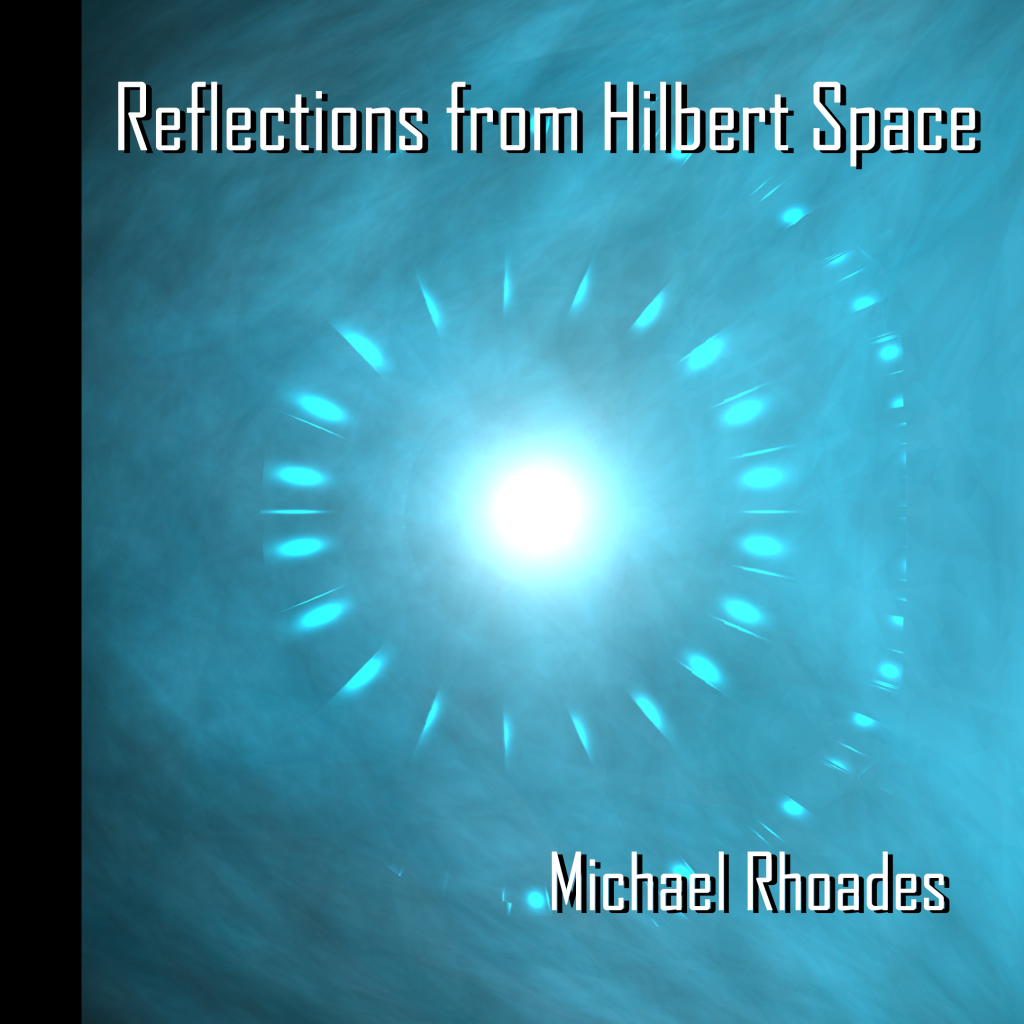
| Track 1: Looking Toward Hilbert Space
| 9:53 | ||
| Track 2: Quantum Etude_00
| 00:24 | ||
| Track 3: the Superstring Octet
| 10:49 | ||
| Track 4: Collapsing Waves
| 10:19 | ||
| Track 5: Entangled Ambience
| 15:09 | ||
| Track 6: Song of Interference (in three movements)
| 11:05 | ||
| Track 7: The Infinite and the Infinitesimal (in four movements)
| 18:23 | ||
| Track 8: The Infinite and the Infinitesimal (condensed)
| 5:41 |
In quantum mechanics, Hilbert space is an infinite-dimensional, complex vector space that serves as the mathematical basis for describing all possible states of a quantum system. Each state is represented by a vector symbolized as |ψ⟩ (the wave function). Since wave functions collapse when measured, we can only observe them as inferred by measurement. In other words, we observe quantum wave field interferences through their reflections.
The compositions in Reflections From Hilbert Space represent the results of QCC research and creative practice in quantum computing and artificial intelligence. There is an arc to their order. The opening piece was a general target for the level of musical expression for the project. The subsequent works begin by investigating workflows and timbral relationships. As the research progressed, the compositions became more about the music than the methodology. The final piece, The Infinite and the Infinitesimal, is the crowning achievement: a fully hardware-derived work transduced directly from quantum circuit execution on Quantum Inspire’s Tuna-9 processor. What you are hearing are the qubits as they interact with each other, composed into a musically relevant form.
→ For more information see Phase II – Quantum Computer Music in the Research section.
Dance of the Qubits is a unified visual music composition in which both the music and the visual environment are derived from identical quantum hardware execution. Eight circuit schemas, each representing a distinct entanglement topology, produce eight paired audio and visual expressions assembled into a single coherent work. The visual objects are not representations of quantum physics — their movements, spatial positions, and interactions are exact mathematical transductions of qubit pre-measurement states, authentic records of quantum entanglement and decoherence rendered directly into perceptual space. The work presented here is a first draft preview of a composition currently in production, intended for presentation in immersive virtual reality environments.
→ For more information see Phase III — Visual Music in the Research section.
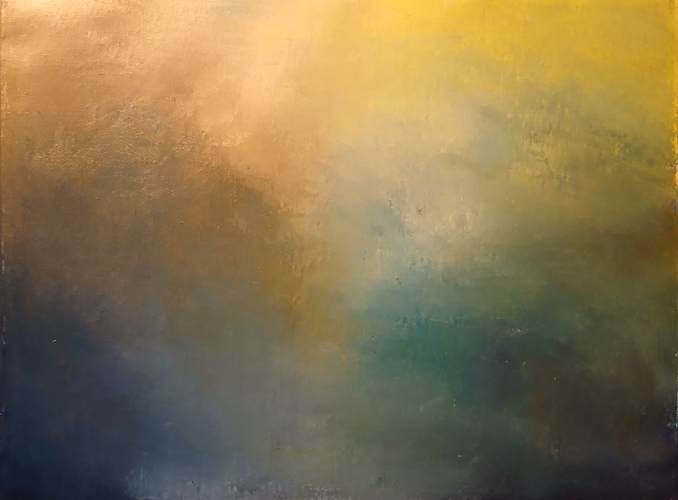
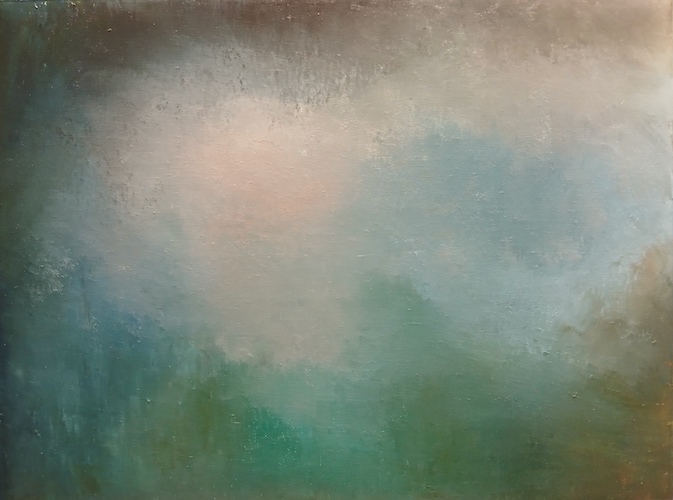
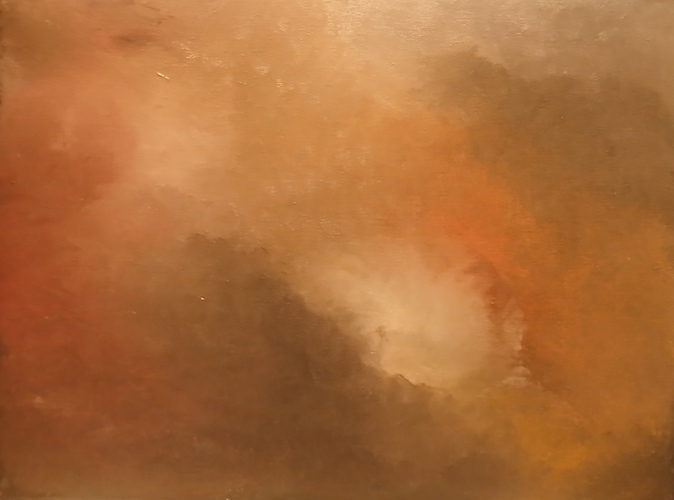
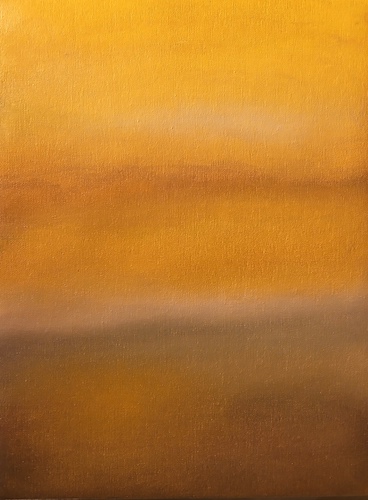
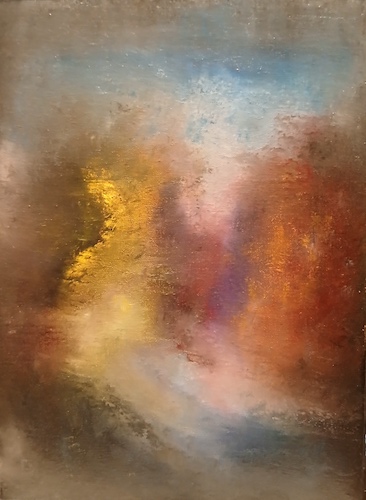
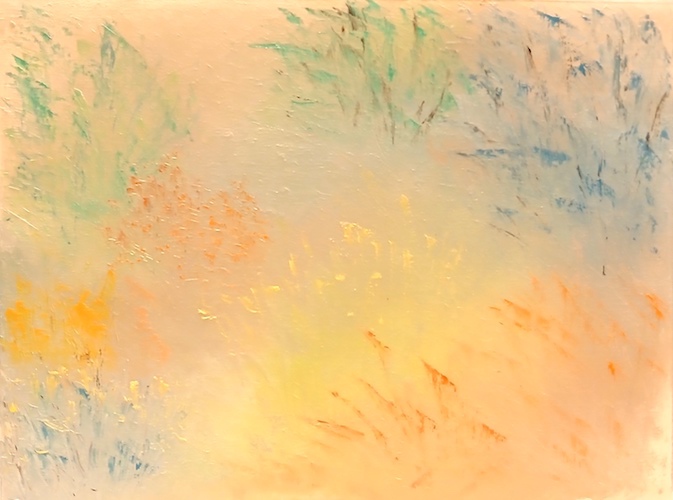
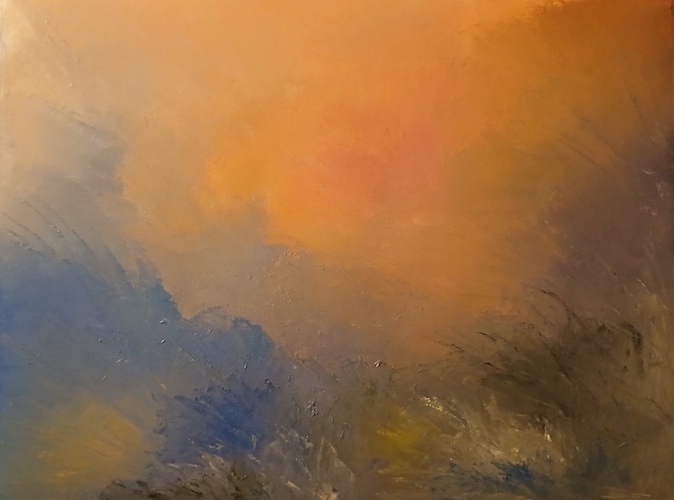
The Atmospherics oil painting series shares the deepest thesis of the Quantum Computational Creativity research program. These indistinct landscapes consist of continuous atmospheric color fields with no hard edges, no discrete boundaries, and embody in paint the same argument that quantum physics makes mathematically: that continuous reality resists the discrete categories human perception imposes upon it. The amber and teal color families recurring throughout the series appear again in the Phase III visual work, not by design but by natural convergence, the same aesthetic impulse finding expression in two different media. Phase V of the research program envisions making continuous quantum reality directly perceptible without the discretizing step of measurement. The Atmospherics paintings are an intuitive anticipation of that vision and are included here not as illustrations of the research but as works that share its spirit.
→ For more information see Phase V — Visual Music in the Research section.